Course Curriculum
Arabic Language Courses
Learn to read, write, speak & understand Arabic
Designing a curriculum for your virtual classes using these three powerhouse texts creates a logical bridge from literacy to conversational fluency and finally to classical mastery. This modular curriculum is grouped into Beginner, Intermediate, and Advanced levels.
Prerequisites & pacing
Complete at least intermediate Arabic before starting Quranic studies. Each level typically takes 2–4 months based on your pace and availability.
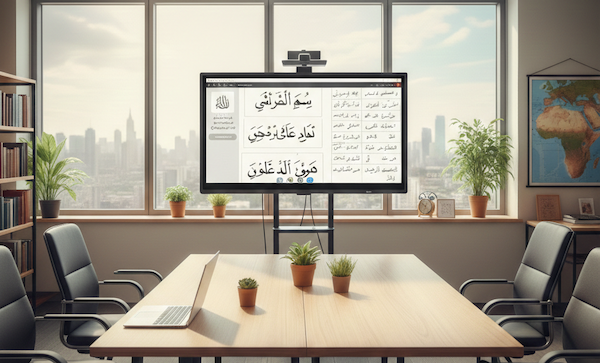
A modular path from literacy to conversational fluency and classical mastery — using Al Qaidah An-Noraniah, the Madinah Books, and Al-Ajrumiyyah.
Enroll in Arabic LanguageWhat you will learn by level
Full module breakdown — nothing omitted
Level 1: Beginner
Literacy and Foundations
Focus: Literacy and Foundations
Primary resource: Al Qaidah An-Noraniah
Objective: Transition from zero knowledge to reading the Arabic script fluently with correct phonetics (Tajweed).
Module 1: The Building Blocks
The Single Letters
Mastering the 28 Arabic letters in their isolated forms.
Correct Articulation (Makharij)
Scientific placement of the tongue and lips for each sound.
Phonetic Vowels
Learning the Fathah, Kasrah, and Dammah (short vowels).
Module 2: The Art of Connection
Compound Letters
Identifying letters in their initial, medial, and final forms.
The Long Vowels
Mastering the Alif, Waw, and Ya extensions (Madd).
Double Vowels (Tanween)
Understanding the 'n' sound at the end of nouns.
Module 3: Advanced Literacy
The Sukoon & Shaddah
Learning to stop on a letter and how to double the sound of a consonant.
Practical Fluency
Reading multi-syllable words and short sentences with rhythmic accuracy.
Continues into Level 2: Intermediate: Language and Conversation
Level 2: Intermediate
Language and Conversation
Focus: Language and Conversation
Primary resource: Durusul Lugatul Arabiyah (Madinah Books)
Objective: Building a functional vocabulary and understanding how to construct and use the Arabic language in daily life.
Module 4: Everyday Communication
Foundational Nouns
Identifying objects, family members, and professions.
The Solar and Lunar Letters
Perfecting the pronunciation of the definite article (Al-).
Demonstrative Pronouns
Mastering "This" and "That" for masculine and feminine subjects.
Module 5: Sentence Architecture
Possession (Idafah)
Learning how to say "The teacher's book" or "The door of the house."
Prepositions & Place
Using words like "In," "On," and "From" to describe location.
Adjectives
Understanding how to describe things (The big house vs. The small car).
Module 6: Narrative and Verbs
The Verb System
Introduction to past and present tense actions.
Pronoun Mastery
Using attached and detached pronouns (I, You, He, She, We).
Interrogatives
Learning how to ask "Who," "What," "Where," and "Why."
Continues into Level 3: Advanced: Classical Grammar and Syntax
Level 3: Advanced
Classical Grammar and Syntax
Focus: Classical Grammar and Syntax
Primary resource: Al Ajrumiyyah
Objective: Mastering the science of I'rab (inflection) to understand the deep structure of classical texts and the Quran.
Module 7: The Science of Speech (Kalam)
Definitions of Speech
Categorizing every Arabic word into Nouns, Verbs, or Particles.
Signs of the Noun and Verb
Learning the technical markers that distinguish parts of speech.
Module 8: The System of Inflection (I'rab)
The Four States
Deep dive into Raf' (Nominative), Nasb (Accusative), Jarr (Genitive), and Jazm (Jussive).
Vowel Changes
Understanding why word endings change based on their role in a sentence.
Module 9: Sentence Analysis
The Subject & Predicate (Mubtada & Khabar)
Breaking down nominal sentences.
The Doer (Fa'il)
Identifying the subject in verbal sentences and its grammatical rules.
Advanced Particles
Understanding how "Inna" and "Kaana" transform sentence meanings and endings.
Why this works
Noraniah ensures students don't have an accent and can read. Madinah Books gives them the “meat”—words they can actually speak. Ajrumiyyah gives them the “skeleton”—the rules that hold everything together so they can eventually read texts without vowels.